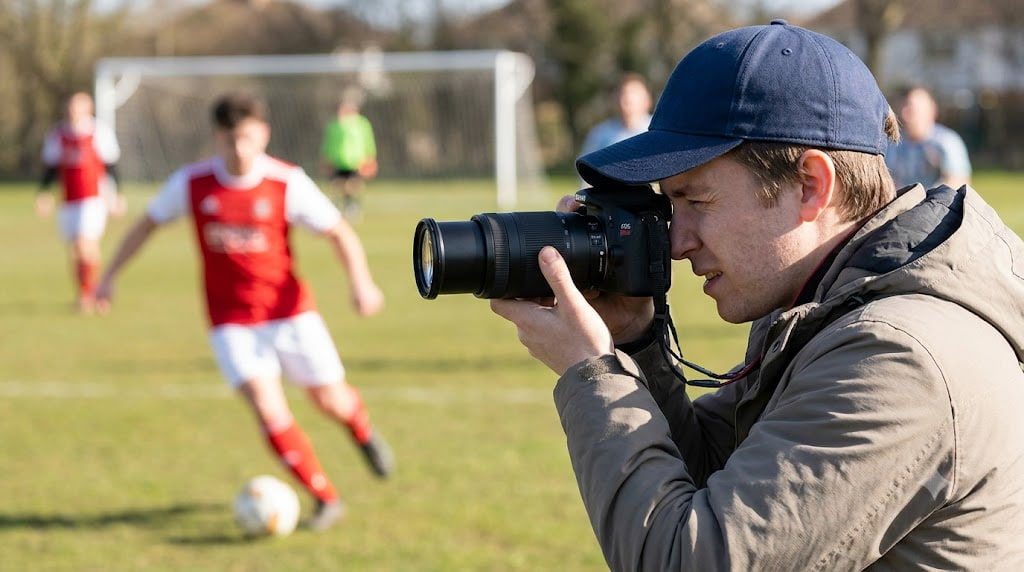
Quick answer: If you want one camera that just works for sports without draining your bank account, go with the Canon EOS R50 (kit, around ₹68,000–75,000) if you’re starting out, or the Nikon Z50 II (around ₹78,000–90,000 with lens) if autofocus tracking matters more to you than price. Need real reach for cricket or wildlife-style sports shots? Pair the Sony Alpha a6400 with a 70-300mm or 100-400mm lens instead. We’ll get into the “why” below, but if you’re in a hurry, that’s your shortlist.
Now let’s talk about why those three keep coming up – and which one actually fits your kind of sports photography.
Megapixels Won’t Save Your Sports Photos. Here’s What Will.
Most people walk into a camera shop asking about megapixels. That’s the wrong question. A 24MP sensor and a 32MP sensor will look nearly identical printed at A4 size. What actually decides whether you come home with a sharp shot of a striker mid-shot or a blurry mess is a completely different set of specs:
- Autofocus and subject tracking – can it lock onto a moving player and stay locked?
- Burst shooting speed – how many frames per second can it fire?
- Shutter speed range – can it freeze a badminton smash or a fast break?
- Lens availability – is there an affordable telephoto lens for this mount?
- High-ISO performance – does it stay clean under stadium floodlights or indoor courts?
- Buffer capacity – can it keep shooting bursts without choking mid-play?
- Ergonomics – can you hold and operate it for three hours straight?
- Battery life – will it survive a full tournament day?
- Weight – are you carrying this around a ground with a 300mm lens attached?
- Total system cost – body plus a usable telephoto lens, not just the body price
Once you start filtering cameras through this list instead of the spec sheet on the box, the shortlist gets a lot shorter – and a lot more useful.
A rough rule of thumb for Indian buyers: under ₹50,000, you’re mostly buying a good all-rounder with average AF; ₹50,000–₹1,00,000 gets you a genuinely capable APS-C mirrorless body with strong tracking; above ₹1,00,000, you start unlocking pro-grade burst speeds and buffer depth. Budget for the lens alongside the body – a bare camera body without a telephoto lens is close to useless for sports.
Quick Picks: Best Budget Sports Cameras at a Glance
| Camera | Best For | Approx. Budget (Body/Kit) | Burst Speed | Autofocus | Lens Ecosystem |
| Canon EOS R50 | Beginners | ₹68,000–₹75,000 | Up to 15 fps (electronic) | Very Good | Growing (RF-S) |
| Canon EOS R10 | Best Value | ₹80,000–₹1,03,000 | Up to 23 fps (electronic) | Excellent | Excellent (RF/RF-S) |
| Nikon Z50 II | Best AF Tracking | ₹78,000–₹90,000 | Up to 30 fps (JPEG) | Excellent | Growing (Z-mount) |
| Sony Alpha a6400 | Fast Action + Reach | ₹65,000–₹75,000 (body) | 11 fps | Very Good | Excellent (E-mount, huge third-party support) |
| Nikon D7500 (new/used) | Wildlife + Sports (DSLR) | ₹55,000–₹85,000 | 8 fps | Very Good | Excellent (F-mount, huge used market) |
Note: Camera prices in India move around constantly with festive sales, GST changes and stock cycles, so treat these as ballpark figures and check current listings on Amazon.in, Flipkart, or authorised dealers before buying.
What to Look for in a Budget Sports Camera
Fast and Reliable Autofocus
This is the single biggest factor separating a “meh” sports camera from a genuinely good one. You want continuous autofocus (Canon calls it Servo AF, Nikon calls it AF-C, Sony calls it AF-C too) combined with subject tracking that can recognise and stick to a person even when they’re weaving between other players.
Look specifically for eye-detection or subject-detection autofocus, wide AF coverage across the frame (not just a cluster of points in the centre), and tracking that holds on when your subject is briefly blocked by another player. This matters more than resolution because a technically sharp 40MP photo of the wrong focus point is still a miss.
High Continuous Shooting Speed
Burst speed decides how many chances you get at the decisive moment – the header, the six, the smash. Here’s roughly what different speeds mean in practice:
- 5 fps – fine for casual shooting, but you’ll miss peak action in fast sports
- 10 fps – a solid working speed for cricket, football, and most outdoor sports
- 15–20+ fps – ideal for badminton, basketball, and anything with sudden bursts of speed
Also check whether that top speed uses the mechanical or electronic shutter. Electronic shutters go faster and silently, but can introduce “rolling shutter” distortion on very fast subjects, like a golf swing or a fast-moving vehicle.
Fast Shutter Speed
Freezing motion comes down to shutter speed, not burst rate. As a working baseline:
- 1/500 sec – decent for slower movement like athletics warm-ups or golf
- 1/1000 sec – the sweet spot for cricket, football, and most field sports
- 1/2000 sec and above – needed for genuinely fast subjects like badminton smashes or motorsports
Every camera on this list can hit these speeds in good light. The real test is whether it can hold that shutter speed and still expose properly indoors or under evening floodlights – which brings us to ISO.
Good High-ISO Performance
Evening matches and indoor sports (badminton, basketball, table tennis) push your ISO way up because you need a fast shutter speed even when there’s not much light around. A camera that produces clean, usable images at ISO 3200–6400 gives you far more flexibility than one that turns to mush past ISO 1600. This is one area where APS-C sensors genuinely outperform smaller sensors, and it’s a big reason we’re not recommending compact or bridge cameras in this guide.
Buffer Capacity (The Spec Everyone Ignores)
A camera advertising 15 fps sounds great until you realise it can only sustain that for 20 frames before it locks up while writing to the card. That’s a two-second burst – nowhere near enough for a full cricket over or a football attack.
The real formula is: fps + buffer depth + card write speed = usable sports performance. Always check a camera’s buffer rating in RAW, not JPEG, since RAW files fill the buffer far faster. Pair any of these cameras with a fast UHS-II SD card if the slot supports it – it makes a real difference during long bursts.
Lens Availability (This Matters More Than the Body)
Here’s the section most buying guides gloss over, and it’s arguably the most important one. The camera body captures light; the lens determines what you can actually capture. A cheaper body with the right lens will consistently beat an expensive body with the wrong one.
Rough focal length guide by sport:
| Sport | Useful Focal Range |
| Cricket | 200–600mm |
| Football | 70–300mm / 100–400mm |
| Basketball | 24–70mm (courtside) or 70–200mm |
| Badminton | 70–200mm (indoor, tight courts) |
| Athletics/Track | 100–400mm |
| Motorsports | 100–400mm / 150–600mm |
If you shoot mostly from the boundary line at a cricket ground, you need real reach – a 55–250mm kit lens won’t cut it. If you’re courtside at basketball or badminton, a mid-range zoom does the job because you’re physically closer to the action.
Battery Life
Tournaments run long. A single school sports day, a full T20 match, or a multi-hour athletics meet will chew through a battery rated for 300-odd shots per charge much faster than the CIPA number suggests, especially if you’re using continuous AF and burst mode a lot. Carrying a spare battery isn’t optional for serious sports shooting – it’s standard practice. DSLRs generally still edge out mirrorless cameras here, though the gap has narrowed a lot in the last couple of years.
Ergonomics and Handling
You’ll be holding this camera up, tracking a moving subject, and firing bursts for hours at a stretch – often with a heavy telephoto lens hanging off the front. A deep grip, a top LCD or clear viewfinder, and controls you can reach without looking down all matter more than they sound like they should. If possible, hold the camera in-store before buying, especially with a longer lens mounted, since weight distribution changes the whole feel.
Best Budget Cameras for Sports Photography
1. Canon EOS R50 – Best Overall Budget Sports Camera
The R50 punches well above its price. It borrows autofocus tech from Canon’s higher-end R-series bodies, which means genuinely good subject detection and tracking at a price that doesn’t require a second job.
- Autofocus: Dual Pixel CMOS AF II with subject detection (people, animals, vehicles)
- Burst rate: Up to 15 fps electronic shutter
- Sensor: 24.2MP APS-C
- ISO range: 100–32,000 (expandable)
- Video: 4K up to 30p
- Weight: Around 375g body only – genuinely light for a full day of shooting
- Lens compatibility: Canon RF and RF-S mount
Pros
- Excellent autofocus for the price bracket
- Very light and easy to carry for long sessions
- Beginner-friendly menus without feeling dumbed down
Cons
- Single SD card slot, no in-body stabilisation
- Native RF-S telephoto lens options are still limited in India
Best for: Beginner sports photographers who want reliable autofocus without a steep learning curve Ideal lens: RF-S 55-210mm to start, upgrade to RF 100-400mm later Verdict: The R50 is the camera we’d point a first-time sports shooter towards. It’s light, the autofocus genuinely tracks moving subjects, and the total cost stays sane once you add a telephoto lens.
2. Sony Alpha a6100 – Best Entry-Level Option
The a6100 has been around a while, but Sony’s autofocus system was ahead of its time when this launched, and it still holds up well today – especially at this price point.
- Autofocus: Real-time Eye AF and tracking, 425 phase-detection points
- Burst rate: 11 fps
- Ease of use: Slightly steeper menu learning curve than Canon/Nikon, but customisable once set up
- Lens options: Massive E-mount ecosystem, including budget third-party glass from Tamron and Sigma
- Beginner friendliness: Good, once you get past the initial menu diving
Best for: Buyers who want Sony’s autofocus reputation without paying flagship prices Ideal lens: Tamron 70-300mm f/4.5-6.3 Di III RXD – light, sharp, and genuinely affordable Verdict: If your budget is tight but you don’t want to compromise on tracking autofocus, the a6100 with a Tamron zoom is one of the smartest combos on this list.
3. Nikon Z50 II – Best Affordable Mirrorless Camera
Nikon took its time catching up in mirrorless, but the Z50 II shows it. This is currently one of the strongest AF systems you’ll find under ₹1,00,000, built around the same processing engine used in Nikon’s professional bodies.
- Tracking: 3D-Tracking plus nine subject-detection modes, including people and animals
- Burst shooting: Up to 30 fps in a cropped high-speed mode, around 11 fps at full resolution
- Weight: Approx. 550g with battery and card – noticeably more solid in hand than the Canon R50
- Modern autofocus: Genuinely one of the best in this price bracket, full stop
Best for: Photographers who prioritise autofocus accuracy over ultimate price Ideal lens: Nikkor Z DX 50-250mm f/4.5-6.3 to start Verdict: For anyone who’s been burned by a camera that “focuses on the wrong thing” during fast action, the Z50 II fixes that problem convincingly. It’s the AF upgrade pick on this list.
4. Sony Alpha a6400 – Best Camera for Cricket Photography
The a6400 remains one of the most recommended cameras for reach-heavy sports like cricket, mostly because of how mature and affordable the E-mount telephoto lineup has become.
- Reach: Compatible with everything from the budget Tamron 70-300mm to the Sigma 100-400mm and beyond
- Crop factor: 1.5x APS-C crop stretches every lens’s effective reach
- Tracking: Real-time tracking that locks onto a batsman or bowler reliably
- Autofocus: Still genuinely competitive years after launch
Best for: Cricket and outdoor field-sport shooters who want serious reach without a full-frame budget Ideal lens: Sigma 100-400mm f/5-6.3 DG DN OS for boundary-line shooting Verdict: Pair this body with a 100-400mm lens and you have a setup that genuinely competes with rigs costing twice as much, purely because Sony’s E-mount lens ecosystem is that deep.
5. Nikon D7500 – Best DSLR for Sports Photography on a Budget
A lot of Indian buyers still lean towards a used or refurbished DSLR, and honestly, that instinct isn’t wrong. The D7500 remains a genuinely capable sports camera, especially when bought used with a healthy shutter count.
- Autofocus: 51-point AF system, well-proven for tracking
- Burst rate: 8 fps with a deep buffer for its class
- Sensor: 20.9MP APS-C, excellent high-ISO performance for a DSLR
- Battery life: Class-leading – DSLRs still win here
- Lens compatibility: Massive F-mount ecosystem, including cheap used telephotos
Best for: Buyers comfortable with an optical viewfinder and a slightly heavier body Ideal lens: Nikon AF-P 70-300mm or a used Tamron/Sigma 150-600mm Verdict: If you’re open to buying used, a D7500 body with a well-maintained telephoto lens can outperform a brand-new entry-level mirrorless kit at a similar total price.
6. Fujifilm X-T30 II – Best Camera for Indoor Sports
Fujifilm doesn’t get talked about enough in sports photography circles, but the X-T30 II’s sensor and colour handling under artificial light make it a genuinely strong pick for indoor courts and evening events.
- High ISO: Clean files up to ISO 6400, very usable even at 12800 in a pinch
- Autofocus: Face and eye detection works reliably under gym lighting
- Low-light performance: One of the better APS-C sensors for mixed indoor lighting
- Fast lenses: Fujifilm’s prime lens lineup (35mm f/1.4, 56mm f/1.2) lets you shoot wide open when light is scarce
Best for: Badminton, basketball, table tennis, and other indoor sports shooters Ideal lens: XF 50-140mm f/2.8 if budget stretches, or XC 50-230mm for a cheaper start Verdict: Where most budget cameras struggle once the sun goes down, the X-T30 II keeps images clean and colours accurate – a genuine advantage for indoor sports coverage.
7. Canon EOS R10 – Best Value for Fast-Moving Team Sports
If your budget allows a small stretch beyond the R50, the R10 is worth it purely for the jump in burst speed and buffer depth.
- Burst rate: Up to 15 fps mechanical, 23 fps electronic
- Autofocus: The same excellent Dual Pixel CMOS AF II system found in Canon’s pricier bodies
- Buffer: Noticeably deeper than the R50, so you can hold a burst through a longer play
- Body: Slightly larger grip, better for people with bigger hands or heavier lenses
Best for: Football, basketball, and any fast-paced team sport where you’re firing long bursts Ideal lens: RF-S 18-150mm as a walk-around, RF 100-400mm for real reach Verdict: The extra spend over the R50 buys you a genuinely faster, deeper-buffered camera – worth it if you regularly shoot fast team sports rather than occasional matches.
8. Nikon D5600 – Best Affordable Camera for Absolute Beginners
For someone who’s never picked up anything beyond a phone camera, the D5600 remains a gentle, forgiving entry point, especially when bought as a used or open-box unit.
- Learning curve: Guide modes and a simple menu system make this genuinely beginner-friendly
- Controls: Physical dials teach exposure basics naturally, without menu diving
- Automatic modes: Sports scene mode gives new shooters a safety net while they learn manual settings
- Upgrade path: F-mount lenses carry over if you later move to a D7500 or similar body
Best for: First-time buyers, students, and parents shooting their kids’ school sports Ideal lens: AF-P DX 70-300mm – light, affordable, and genuinely sharp Verdict: Not the fastest or flashiest camera here, but for someone learning the ropes on a tight budget, it removes the intimidation factor without removing the ability to grow.
Best Sports Cameras by Budget
Under ₹50,000
At this level, you’re choosing between a used/refurbished DSLR body with a telephoto lens, or a base mirrorless body with a very basic kit lens. Realistically, put most of the budget into the lens – a used Nikon D5600 or Canon 1500D with a 70-300mm lens will outshoot a brand-new body with a stock 18-55mm kit lens every time for sports.
Under ₹75,000
This is a genuine sweet spot in the Indian market right now. It’s where the Canon EOS R50 and Sony a6100 sit comfortably with a kit lens included, giving you modern autofocus and 4K video without stretching into serious money.
Under ₹1,00,000 (₹1 Lakh)
Here you can realistically get a Nikon Z50 II or Canon EOS R10 body paired with a mid-range telephoto like a 55-250mm or 70-300mm – a setup that covers 90% of amateur and semi-serious sports shooting needs.
Under ₹1.5 Lakh
At this level, look at body-plus-lens combos that unlock genuinely faster burst rates and deeper buffers – for instance, a Canon EOS R10 or Sony a6400 paired with a proper 100-400mm lens, or stretching to a Canon R7 body if you want IBIS and 32.5MP resolution thrown in.
Best Used Camera for Sports Photography
Buying used is one of the smartest moves for budget-conscious Indian buyers, provided you check a few things carefully:
- Shutter count – under 20,000 actuations is generally safe for a body with a 100,000+ rated shutter
- Sensor condition – check for dust spots or scratches, easiest to spot by shooting a plain white/blue sky at f/16
- Autofocus – test AF speed and accuracy across all focus points, not just the centre
- Battery – ask for the original charger, and check if the battery still holds a reasonable charge
- Lens condition – check for fungus, haze, or a loose zoom ring (a common issue with older telephotos)
- Warranty – buy from a dealer offering at least a short replacement warranty, not a random online listing
- Seller reputation – stick to known platforms or dealers with verifiable reviews and physical stores where possible
Which Camera Is Best for Different Sports?
Cricket needs real reach – 200–600mm equivalent – plus solid autofocus and a burst rate that can hold through an entire over. Stadium lighting varies wildly, so decent high-ISO performance matters too.
Football rewards fast tracking autofocus since players change direction unpredictably. A 70-300mm or 100-400mm lens covers most pitch-side shooting positions, paired with a high burst rate for goal-mouth action.
Basketball is fast and often indoors, so you need a quick shutter speed and strong low-light performance. A combination of a wider lens for courtside shots and a short telephoto for full-court action works best.
Badminton might be the toughest sport to shoot – the shuttle moves at absurd speeds and matches happen indoors under artificial light. This is where high shutter speeds (1/2000 sec+), strong AF tracking, and clean high-ISO files all matter simultaneously.
Athletics benefits from tracking autofocus that can follow a sprinter across the frame, combined with a long lens (100-400mm) to isolate athletes from the crowd.
Motorsports is about panning and tracking vehicles moving fast and predictably along a line. Burst rate and a long focal length (150-600mm for trackside shots) matter more here than almost anywhere else.
Should You Spend More on the Camera or the Lens?
Here’s the uncomfortable truth most camera shop salespeople won’t tell you: a ₹80,000 camera body with the wrong lens will consistently produce worse sports photos than a ₹40,000 body paired with an appropriate telephoto lens.
Where the camera body matters:
- Autofocus system quality
- Burst shooting speed
- High-ISO noise handling
- Buffer depth for sustained bursts
Where the lens matters:
- Focal length (does it actually reach the subject?)
- Maximum aperture (how much light can it gather?)
- Autofocus motor speed within the lens itself
- Image stabilisation for handheld telephoto shooting
A practical budget split:
- If you shoot mostly outdoor sports with decent light (cricket, football, athletics): lean 50% body / 50% lens, since a longer lens genuinely transforms your reach.
- If you shoot mostly indoor sports (badminton, basketball): lean 60% body / 40% lens, since sensor and AF quality matter more than raw reach indoors.
Either way, don’t buy a camera body and plan to “get a lens later” indefinitely – a body without a proper telephoto lens simply can’t do sports photography justice.
Best Affordable Lenses for Sports Photography
| Lens | Approx. Price | Best For | Reach | Low Light | Beginner Friendly |
| Canon RF-S 55-210mm f/5-7.1 | ₹18,000–₹22,000 | General field sports | Good | Average | Yes |
| Tamron 70-300mm f/4.5-6.3 Di III (Sony E) | ₹35,000–₹40,000 | Football, cricket | Excellent | Good | Yes |
| Nikkor Z DX 50-250mm f/4.5-6.3 | ₹28,000–₹32,000 | Athletics, football | Good | Average | Yes |
| Sigma 100-400mm f/5-6.3 DG DN | ₹65,000–₹75,000 | Cricket, wildlife-style sports | Excellent | Good | Moderate |
| Fujifilm XC 50-230mm f/4.5-6.7 | ₹25,000–₹30,000 | Indoor + outdoor mix | Good | Average | Yes |
Lens prices in India shift regularly with import duties and dealer stock, so always cross-check current listings before buying.
Best Telephoto Lens for Beginners
Start with your kit’s native 55-210mm or 50-250mm equivalent lens. It’s light, affordable, and good enough to figure out whether you actually enjoy sports photography before spending big.
Best Budget Lens for Cricket
The Tamron 70-300mm or Sigma 100-400mm, depending on your mount and how much reach you genuinely need from the boundary line.
Best Budget Lens for Football
A 70-300mm class lens hits the sweet spot between reach and weight for sideline shooting.
Best Lens for Indoor Sports
Look for something with a wider maximum aperture, like an f/2.8 zoom or an affordable fast prime – light-gathering ability matters more than raw reach in a gym or indoor court.
DSLR vs Mirrorless for Sports Photography
| Feature | DSLR | Mirrorless |
| Autofocus | Good | Excellent |
| Burst shooting | Good | Excellent |
| Weight | Heavier | Lighter |
| Battery life | Often better | Improving fast |
| Lens availability | Excellent (huge used market) | Excellent (growing fast) |
| Used market | Excellent | Growing |
| Beginner usability | Good | Excellent |
Should beginners still buy a DSLR? Yes, in specific cases – particularly if you’re buying used and want to put most of your money into a good telephoto lens rather than the latest sensor tech. A used Nikon D7500 with a solid 70-300mm lens is still a genuinely competent sports setup, and the used DSLR market in India remains deep and reasonably priced.
APS-C vs Full-Frame for Budget Sports Photography
APS-C advantages:
- Noticeably lower cost for both bodies and lenses
- Smaller, lighter bodies that are easier to carry all day
- The crop factor effectively extends your telephoto reach (a 300mm lens behaves like roughly 450-480mm)
- Genuinely excellent for beginners and intermediate shooters
Full-frame advantages:
- Better low-light and high-ISO performance
- Broader lens selection at the premium end
- More headroom for cropping heavily while retaining detail
- The choice most working professionals eventually move to
Verdict: For most budget sports photographers in India, APS-C offers significantly better value. The extra reach from the crop factor is actually a genuine advantage for sports, not just a compromise – you get more effective focal length per rupee spent on glass.
Best Budget Camera and Lens Combinations
Best Beginner Setup
Canon EOS R50 (or Sony a6100) + 55-250mm equivalent lens Budget: Around ₹85,000–₹95,000 for both Best for: School sports, amateur cricket, football, general outdoor events
Best Cricket Photography Setup
Sony a6400 + Sigma 100-400mm Budget: Around ₹1,35,000–₹1,50,000 for both Best for: Boundary-line cricket, athletics, anything needing real reach
Best Indoor Sports Setup
Fujifilm X-T30 II + XF 50-140mm f/2.8 (or a fast prime if budget is tight) Budget: Around ₹1,50,000+ with the f/2.8 zoom, considerably less with a prime Best for: Badminton, basketball, indoor tournaments
Best Professional-Looking Budget Setup
Canon EOS R10 + RF 100-400mm f/5.6-8 Budget: Around ₹1,60,000–₹1,80,000 for both Best for: Anyone wanting near-professional results without a professional-grade price tag
Best Camera Settings for Sports Photography
Shutter Speed by Sport
| Sport | Suggested Starting Point |
| Cricket | 1/1000 sec or faster |
| Football | 1/1000 sec |
| Basketball | 1/800–1/1000 sec |
| Badminton | 1/1000–1/2000 sec |
| Motorsports | 1/500–1/1000 sec (slower for intentional panning) |
Autofocus Mode
Use continuous autofocus (AF-C / Servo AF) for nearly all sports shooting. Within that, wide-area or zone AF tends to be more forgiving for beginners than pinpoint single-point AF, since it gives the tracking system a larger area to lock onto a moving subject.
Aperture
- f/2.8 – best for indoor sports or when you want strong background separation
- f/4 – a solid all-purpose choice for outdoor field sports
- f/5.6 – common on budget telephoto zooms; fine in good daylight, more challenging as light drops
ISO
Auto ISO with a capped maximum (say, ISO 6400) is genuinely the smarter choice for most sports shooters, since it lets you lock shutter speed and aperture as priorities while the camera handles brightness. Manual ISO makes sense once you’re comfortable reading light conditions on the fly.
Burst Mode
Use your camera’s high-speed continuous mode by default for any fast action. It costs you nothing except card space, and it dramatically increases your odds of nailing the peak moment.
RAW vs JPEG
Shoot RAW if you plan to edit afterwards – it gives you much more room to recover exposure and white balance mistakes. If you’re a beginner just getting comfortable, shooting RAW+JPEG together is a good middle ground: you get an instantly shareable JPEG plus the RAW file to learn editing on later.
Common Sports Photography Mistakes to Avoid
- Chasing megapixels over autofocus – a high-resolution sensor with poor tracking will still miss more shots than a lower-resolution one with great AF
- Using a lens that’s too short – a kit 18-55mm simply cannot reach across a football pitch or cricket ground
- Shooting at too slow a shutter speed – motion blur ruins more sports shots than any other single mistake
- Ignoring ISO – being too conservative with ISO often costs you the shutter speed you actually need
- Using single-shot autofocus – this locks focus once and won’t track a moving subject afterwards
- Holding the camera incorrectly – a loose or unsupported grip leads to shake, especially with longer lenses
- Shooting only wide shots – get closer (physically or with a longer lens) for shots that actually show emotion and detail
- Ignoring background distractions – a cluttered background pulls attention away from your subject, even in a technically sharp photo
- Filling the buffer – firing endless bursts without pausing means your camera locks up right when you need it most
- Not practicing before the event – dial in your settings during a warm-up or practice session, not during the actual match
Do You Need a Professional Camera for Sports Photography?
Honestly, no – not to get genuinely good results. Expensive gear helps at the margins, but technique, timing, positioning, lens choice, and shutter speed decisions matter far more than simply owning the most expensive body available. A photographer who understands where to stand, when to press the shutter, and how to use a budget 70-300mm lens well will consistently out-shoot someone with flagship gear and no positioning sense. Buy the best gear your budget comfortably allows, then spend the money you saved on practice and, ideally, a decent lens.
How to Choose the Best Budget Camera for Sports Photography
Choose the Canon EOS R50 if: You’re new to sports photography and want reliable autofocus without a complicated learning curve.
Choose the Fujifilm X-T30 II if: You mostly shoot indoor sports like badminton or basketball under artificial lighting.
Choose the Sony a6400 or Nikon D7500 (with a long lens) if: You need serious reach for cricket or similar boundary-line sports.
Choose the Sony a6100 or Nikon D5600 if: You want a genuinely beginner-friendly camera without overspending on your first setup.
Choose the Nikon Z50 II if: Autofocus tracking accuracy matters more to you than shaving off a few thousand rupees.
Frequently Asked Questions
For most Indian buyers, the Canon EOS R50 offers the best mix of autofocus reliability, price, and lens availability for someone starting out in sports photography.
Yes, as long as it has continuous autofocus and a burst mode of at least 8-10 fps. A budget mirrorless body with the right telephoto lens can produce genuinely strong sports photos.
The Canon EOS R50 and Sony Alpha a6100 are both strong entry-level picks, offering modern autofocus systems without an intimidating learning curve.
Generally yes, mostly due to faster and more accurate autofocus tracking. That said, a used DSLR paired with a good telephoto lens remains an excellent budget option.
Aim for at least 8-10 fps for most sports. Faster-paced sports like badminton or basketball benefit from 15 fps or more.
1/1000 sec is a safe general starting point for most sports, going up to 1/2000 sec for very fast subjects like a badminton shuttle.
It depends on the sport, but a 70-300mm zoom covers most outdoor field sports well, while cricket and wildlife-style shooting benefit from a 100-400mm or longer lens.
Yes – the crop factor actually works in your favour by extending your effective telephoto reach, making APS-C a genuinely smart choice for budget sports photographers.
Yes, provided you pair the body with a lens that has real reach (200mm and beyond). The body alone with a short kit lens won’t be enough.
Often, yes – particularly for DSLRs, where the used market in India is large and well-established. Just check the shutter count, sensor condition, and autofocus performance carefully before buying.
Which Budget Sports Camera Should You Buy?
If you’ve read this far and still can’t decide, here’s the short version:
- Best overall: Canon EOS R50
- Best under ₹50,000: A used Nikon D5600 or Canon 1500D paired with a 70-300mm lens
- Best entry-level: Sony Alpha a6100
- Best for cricket: Sony Alpha a6400 + Sigma 100-400mm
- Best for indoor sports: Fujifilm X-T30 II
- Best used option: Nikon D7500
- Best camera + lens combination: Canon EOS R10 + RF 100-400mm
If you’re just starting out and want one camera that won’t fight you, get the Canon EOS R50. If you already know you’ll be shooting cricket or need serious reach, skip straight to the Sony a6400 with a 100-400mm lens – the body-plus-lens combo matters more than the body alone. And if you’re buying your very first camera on a genuinely tight budget, don’t rule out a well-maintained used DSLR with a proper telephoto lens; it’ll outshoot a brand-new kit lens setup every single time.
Whatever you pick, remember the actual formula for great sports photography: the right shutter speed, a lens with enough reach, autofocus that tracks reliably, and a photographer who’s practiced enough to trust their gear. Get those four things right, and the exact camera model matters a lot less than the marketing would have you believe.

Pradeep Kumar is a passionate writer and product enthusiast who loves exploring unique, trendy, and thoughtful items. With a keen eye for detail, he curates creative gift ideas and shopping inspirations that make every occasion special. His goal is to help readers discover meaningful products that bring joy, value, and a touch of surprise to everyday life.