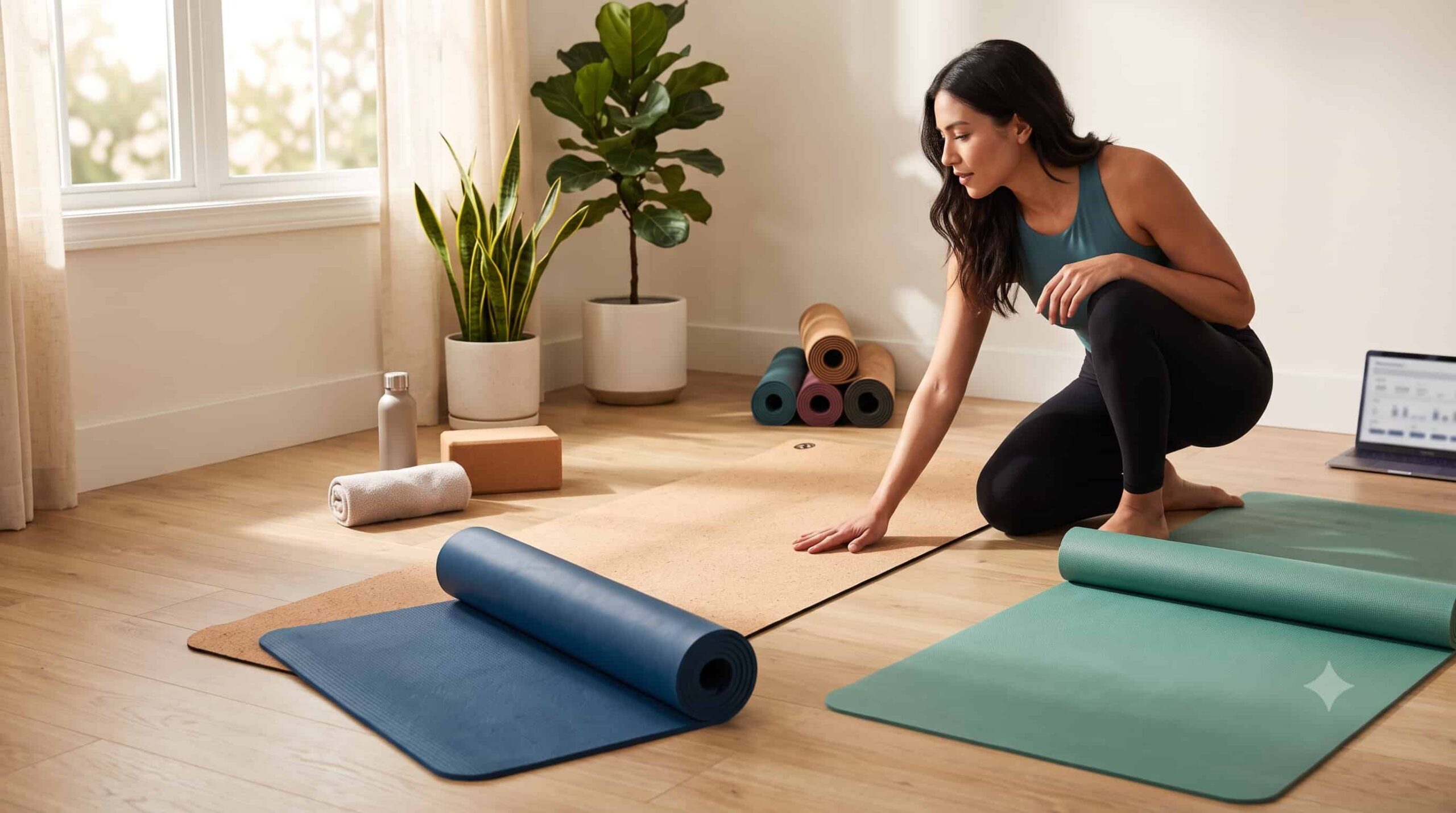
A yoga mat looks like the simplest purchase in your fitness kit, until you buy the wrong one and spend every session sliding around on tile or feeling your knees dig into the floor through a thin sheet of foam. Grip, thickness and stability matter more than the price tag or how the mat looks in photos. A thicker mat isn’t automatically a better one either – extra cushioning can come at the cost of balance, which matters if your floor routine includes planks or standing poses.
This guide is built around how you’ll actually use the mat: the kind of workout you do, the floor you do it on (tile and marble are common in Indian homes and behave very differently from wood or carpet), how much you sweat, and how much you’re willing to spend. Whether you’re searching for the best yoga mat for home workouts, a non-slip mat for HIIT, or something under ₹1,000 that won’t fall apart in six months, you’ll find a clear recommendation below.
Best Yoga Mats for Home Workouts at a Glance
| Rank | Yoga Mat | Best For | Thickness | Material | Grip | Approx. Price |
| 1 | Boldfit ProGrip Yoga Mat | Best Overall | 6mm | TPE | Double-sided, wavy underside | ₹500–₹900 |
| 2 | Wakefit Mantra Double Layer Mat | Best for Joint Comfort | 6mm | TPE (double layer) | Textured top layer | ₹700–₹900 |
| 3 | Strauss TPE Dual Layer Mat | Best for Sweaty Workouts | 6mm / 8mm | TPE | Textured, double anti-slip | ₹700–₹1,000 |
| 4 | Amazon Basics Dual Colour Mat | Best Budget | 6mm | TPE & EVA | Grippy surface | ₹350–₹550 |
| 5 | Lifelong Yoga Mat | Best Under ₹1,000 | 6mm / 8mm | TPE | Anti-slip | ₹500–₹900 |
| 6 | Decathlon Kimjaly Comfort Mat | Best Premium / Beginners | 8mm | Anti-slip foam | Excellent, foam-based | ₹1,999 |
| 7 | Boldfit NBR Yoga Mat | Best for Extra Cushioning | 10mm | NBR | Textured surface | ₹1,200–₹1,800 |
Prices are approximate and can change with online offers and season. Always check the current price before buying.
Quick verdict:
- Best Overall: Boldfit ProGrip Yoga Mat (6mm TPE)
- Best Budget: Amazon Basics Dual Colour Mat
- Best for Beginners: Decathlon Kimjaly Comfort Mat
- Best Non-Slip: Strauss TPE Dual Layer Mat
- Best for Sweaty Workouts: Strauss TPE Dual Layer Mat
- Best for Joint Comfort: Boldfit NBR Yoga Mat (10mm)
- Best Premium: Decathlon Kimjaly Comfort Mat
Our Top Picks: Best Yoga Mats for Working Out
Boldfit ProGrip Yoga Mat – Best Overall
Why we recommend it: This is one of the most widely bought yoga mats in India, and the 6mm TPE version hits a sensible middle ground between cushioning and stability that works for yoga, home workouts and light floor exercises. Boldfit sells it in EVA and TPE variants, and the TPE version is the one worth paying slightly more for – it holds its shape better over time.
Key specifications
- Material: TPE (also available in EVA and NBR variants)
- Thickness: 6mm (5mm–8mm range across the line)
- Dimensions: 183cm x 61cm (6ft x 2ft)
- Grip: Double-sided non-slip surface with a wavy underside for floor traction
- Portability: Comes with a carry strap
- Price: Approx. ₹500–₹900 depending on the variant
Best for: Daily yoga, general home workouts, beginners who want one reliable mat.
Pros
- Reliable grip on both sides, dry and lightly sweaty
- Widely available with consistent stock and quick delivery
- Reasonably priced for the quality on offer
Cons
- The 6mm version isn’t thick enough for people who kneel a lot on hard tile
- Some buyers report the surface wearing down faster with daily heavy use
Who should buy it? Anyone looking for a dependable everyday mat without overthinking the decision.
Who should skip it? Buyers who specifically need extra-thick cushioning for joint pain – look at the NBR or thicker options instead.
Our verdict: A sensible, low-risk pick for most home workout routines. Check Price
Wakefit Mantra Double Layer Yoga Mat – Best for Joint Comfort
Why we recommend it: Wakefit built its reputation on home comfort products, and this mat uses a double-layer TPE construction that’s meant to add stability under the cushioning rather than just piling on foam. It’s a good option if you want a mat that stays flat during downward dog and doesn’t feel mushy underfoot during standing poses.
Key specifications
- Material: TPE, double layer
- Thickness: 6mm
- Dimensions: 183cm x 61cm (72 x 24 inches)
- Grip: Anti-slip, textured top surface
- Care: Manufacturer recommends hand-cleaning; no washing machine or dryer
- Price: Approx. ₹700–₹900 (frequently discounted from a higher MRP)
Best for: Yoga practitioners who want cushioning without the mat feeling unstable during balance poses.
Pros
- Double-layer build feels more supportive than single-layer TPE mats at the same thickness
- Reasonably light for its cushioning level
- Backed by a brand with a large India-wide delivery and returns network
Cons
- Not designed for machine washing, which means more manual upkeep
- Not the best pick for high-intensity, high-sweat workouts – TPE alone doesn’t stay grippy for very long, sweaty HIIT sessions
Who should buy it? People whose routine is mostly yoga, stretching and floor exercises rather than sweat-heavy cardio.
Who should skip it? If your main workout is HIIT or hot yoga, prioritise grip over cushioning instead.
Our verdict: A comfortable, joint-friendly mat for classic yoga practice. Check Price
Strauss TPE Dual Layer Yoga Mat – Best for Sweaty Workouts
Why we recommend it: Strauss markets this mat specifically around its double anti-slip design, with a wavy, textured underside meant to grip tile and wood floors even when your hands and feet are damp. It comes in both 6mm and 8mm thickness, so you can pick based on how much cushioning you want.
Key specifications
- Material: TPE (eco-friendly, PVC and latex-free per manufacturer)
- Thickness: 6mm or 8mm
- Dimensions: 183cm x 61cm
- Grip: Double-sided textured, anti-slip
- Portability: Comes with a carry strap or bag
- Price: Typically in the ₹700–₹1,000 range, varying by thickness and colour
Best for: HIIT, Pilates, and workouts where your hands and feet get sweaty.
Pros
- Textured grip performs better than smooth-surface mats once you start sweating
- Available in a thickness that suits both stability-focused and cushioning-focused users
- TPE material is lighter than rubber or NBR, so it’s easy to roll and store
Cons
- Manufacturer claims around sweat resistance are based on product listings, not independent lab testing
- TPE mats in general show wear faster than natural rubber under daily heavy use
Who should buy it? Anyone doing HIIT, bodyweight circuits or Pilates at home where grip under sweat matters most.
Who should skip it? If you mainly do gentle stretching or meditation, you don’t need this level of grip engineering – a simpler mat will do.
Our verdict: One of the better options specifically for sweat-heavy routines. Check Price
Amazon Basics Dual Colour Yoga Mat – Best Budget
Why we recommend it: If you just want to know whether you’ll actually stick to a home workout routine before spending more, this is a sensible starting mat. It’s a TPE and EVA blend, thinner and lighter than the premium options, but it does the basic job of separating you from a hard floor.
Key specifications
- Material: TPE and EVA blend
- Thickness: 6mm
- Dimensions: Standard 183cm x 61cm
- Grip: Grippy surface, though less textured than dedicated “anti-slip” mats
- Portability: Carry strap included
- Price: Approx. ₹350–₹550 depending on ongoing offers
Best for: First-time buyers, occasional users, students on a tight budget.
Pros
- One of the cheapest mats from a recognisable brand
- Good enough grip for basic yoga and stretching
- Easy to find with fast delivery through Amazon
Cons
- Some buyers report a noticeably strong smell out of the packaging initially
- Grip performance is mixed once you start sweating – reviews are split on this
- Not built for daily, heavy-intensity workouts long-term
Who should buy it? Someone testing out a home workout habit who doesn’t want to commit a large budget upfront.
Who should skip it? If you already know you’ll be doing daily HIIT or hot yoga, spend a bit more on a mat built for grip under sweat.
Our verdict: Solid for getting started; you may want to upgrade once your routine is established. Check Price
Lifelong Yoga Mat – Best Under ₹1,000
Why we recommend it: Lifelong sits in a similar price bracket to Boldfit but tends to offer slightly better cushioning options at the 8mm mark for close to the same price. It’s a straightforward, no-frills TPE mat aimed at home users rather than studios.
Key specifications
- Material: TPE
- Thickness: 6mm or 8mm variants
- Dimensions: 183cm x 61cm
- Grip: Anti-slip surface, dual colour design
- Price: Approx. ₹500–₹900 depending on thickness and ongoing discounts
Best for: Buyers who want extra cushioning at the 8mm level without paying premium prices.
Pros
- 8mm variant offers noticeably more cushioning than most mats in this price bracket
- Lightweight and easy to roll for storage in small apartments
- Frequently available at a discount from listed MRP
Cons
- At 8mm, some users find balance-heavy poses slightly less stable
- Colour and print options are more limited than premium brands
Who should buy it? Anyone who wants more cushioning than a standard 6mm mat but doesn’t want to spend on a premium brand.
Who should skip it? If your workouts are balance-heavy (think single-leg poses or HIIT footwork), a 6mm mat will serve you better.
Our verdict: Good value if cushioning is your priority. Check Price
Decathlon Kimjaly Comfort Yoga Mat – Best Premium / Best for Beginners
Why we recommend it: Decathlon’s Kimjaly range is built around comfort-first gentle yoga, and the 8mm foam mat is noticeably softer underfoot than the TPE options above. It’s priced higher, but it comes with a genuine 2-year warranty and a 30-day return window, which is longer than most competing brands offer.
Key specifications
- Material: Anti-slip foam
- Thickness: 8mm
- Dimensions: 173cm x 61cm
- Grip: Anti-slip surface designed for stability on various floor types
- Warranty: 2 years, with 30-day returns
- Price: Approx. ₹1,999 (frequently discounted from a higher MRP)
Best for: Beginners doing gentle yoga, people with sensitive knees or joints, anyone who wants a longer warranty period.
Pros
- Genuinely soft cushioning that suits kneeling and seated poses
- Longer warranty and return window than most competitors
- Backed by an established retail and after-sales network across India
Cons
- Noticeably more expensive than TPE alternatives with similar thickness
- Extra thickness can reduce stability during balance-focused or high-intensity poses
Who should buy it? Beginners, people managing joint discomfort, or anyone who values after-sales support over shaving off a few hundred rupees.
Who should skip it? If you’re doing HIIT or Pilates where footing and balance matter more than plush cushioning.
Our verdict: The most comfortable option here, at a price that reflects it. Check Price
Boldfit NBR Yoga Mat (10mm) – Best for Extra Cushioning
Why we recommend it: For anyone who finds even 8mm mats too thin – often people with sensitive knees, or those who use the mat for floor exercises rather than standing yoga – this 10mm NBR mat adds real cushioning. NBR (Nitrile Butadiene Rubber) is denser than TPE, so it holds its shape under repeated pressure better than thinner foam mats.
Key specifications
- Material: NBR
- Thickness: 10mm
- Dimensions: 183cm x 61cm
- Grip: Textured surface, carry strap included
- Price: Approx. ₹1,200–₹1,800
Best for: Floor exercises, seated stretches, people with knee or joint sensitivity.
Pros
- Noticeably more cushioned than 6mm or 8mm TPE mats
- NBR holds its shape better than EVA over repeated use
- Good option for anyone who also uses the mat for general floor sitting or stretching
Cons
- Heavier and bulkier to roll and store than thinner mats
- Extra thickness reduces stability for standing balance poses
- Reviewers note the thickness can feel excessive for anyone doing standing yoga sequences
Who should buy it? Anyone prioritising cushioning over portability, especially for floor-based routines.
Who should skip it? If your workouts involve a lot of standing balance poses or HIIT footwork, this mat’s extra give can work against you.
Our verdict: The pick for cushioning-first buyers who don’t mind the extra bulk. Check Price
Which Yoga Mat Is Best for Your Workout?
Best Yoga Mat for Yoga
A 6mm TPE mat, like the Boldfit ProGrip or Wakefit Mantra, balances cushioning for joints with enough firmness to hold standing poses without wobbling.
Best Yoga Mat for Home Workouts
If your routine mixes yoga, stretching and bodyweight exercises, a 6mm mat with strong double-sided grip – the Strauss or Boldfit options – covers the most ground without major compromises.
Best Yoga Mat for HIIT
Grip matters far more than cushioning here. A textured TPE mat like the Strauss Dual Layer holds up better once your hands and feet get sweaty than a smooth or overly plush mat.
Best Yoga Mat for Pilates
Pilates involves a lot of contact between your spine and the floor, so a bit of extra cushioning helps – but you still need stability for core work. A 6mm-8mm TPE mat is the usual sweet spot.
Best Yoga Mat for Stretching
Stretching doesn’t demand much grip engineering, so a simpler, thicker mat – even the NBR 10mm option – works fine here since stability isn’t as critical.
Best Yoga Mat for Surya Namaskar
This sequence moves between standing, lunging and floor positions quickly, so you need a mat that grips in multiple orientations without sliding. A medium-thickness TPE mat with textured grip on both sides performs best.
Best Yoga Mat for Floor Exercises
For crunches, planks and other exercises done mostly lying down or on your knees, extra cushioning (8mm-10mm) is more useful here than in standing routines.
What Thickness of Yoga Mat Should You Buy?
A thicker yoga mat is not automatically a better yoga mat. More cushioning helps protect your knees and spine on hard floors, but too much thickness can make balance poses feel unstable, since your feet sink into the mat instead of pressing against a firm surface.
| Thickness | Best For | Main Advantage | Main Drawback |
| 4mm | Travel, quick sessions, experienced practitioners | Lightweight, easy to carry and store | Little cushioning for knees on hard floors |
| 6mm | General yoga, home workouts, most beginners | Good balance of cushioning and stability | Not enough padding for prolonged kneeling |
| 8mm | Pilates, floor exercises, sensitive joints | Noticeably more comfortable underfoot | Slightly less stable for standing balance poses |
| 10mm–13mm | Floor-based routines, joint pain, general stretching | Maximum cushioning | Can feel unstable and bulky, harder to store |
Is a 4mm Yoga Mat Good for Home Workouts?
It works if you’re experienced, don’t kneel much, and prioritise portability. It’s a poor choice for anyone with knee or wrist sensitivity.
Is a 6mm Yoga Mat Good for Yoga and Exercise?
Yes – this is the default recommendation for most people because it doesn’t force a trade-off between comfort and stability.
Is an 8mm Yoga Mat Good for Home Workouts?
Good for mixed routines involving floor work, though standing balance poses feel slightly less grounded than on a 6mm mat.
Are 10mm–13mm Yoga Mats Too Thick?
Not “too thick” exactly, but they suit a specific use case – floor exercises and joint comfort – rather than general yoga. If your practice is mostly standing sequences, this thickness will work against you.
Which Yoga Mat Material Is Best?
TPE Yoga Mats
Lightweight, reasonably grippy, and the most common material in the Indian market right now. Manufacturers commonly describe TPE as more eco-friendly than PVC since it’s typically free of phthalates and latex.
EVA Yoga Mats
Cheaper and lighter than TPE, often used in budget mats. Grip and durability tend to be a step below TPE and NBR.
PVC Yoga Mats
Durable and grippy, but heavier and less eco-friendly than TPE. Less common now in home-use mats sold in India, more associated with studio-grade mats.
NBR Yoga Mats
Denser and more cushioned than TPE or EVA at the same thickness. Common in thicker mats (10mm+) aimed at comfort over portability.
Natural Rubber Yoga Mats
Known for strong grip, especially when a little damp, and better long-term durability. Heavier than TPE and usually pricier; less commonly stocked by the budget Indian brands covered in this guide.
Cork Yoga Mats
Naturally grippy when slightly sweaty (grip improves with moisture, unlike most synthetic surfaces), and more sustainable. Niche in the Indian market currently, usually priced at a premium.
| Material | Grip | Cushioning | Durability | Weight | Best For |
| TPE | Good | Moderate | Moderate | Light | General yoga, home workouts |
| EVA | Fair | Moderate | Lower | Very light | Budget buyers, occasional use |
| PVC | Very good | Moderate | High | Heavy | Studio-style regular use |
| NBR | Good | High | Moderate–high | Heavy | Floor exercises, joint comfort |
| Natural Rubber | Very good | Moderate | High | Heavy | Sweaty workouts, long-term use |
| Cork | Good (better wet) | Moderate | High | Moderate | Sweat-heavy sessions, eco-conscious buyers |
TPE vs EVA vs NBR: Which Should You Buy?
For most home users, TPE offers the best overall balance of grip, weight and price. Choose EVA only if budget is your top priority and you’re not working out daily. Choose NBR if cushioning matters more to you than portability – it’s the better pick for anyone doing a lot of seated or floor-based work.
How to Choose the Best Yoga Mat for Home Workouts
Choose 4–5mm If…
You travel often with your mat, have no joint sensitivity, and prioritise a lightweight roll-up over cushioning.
Choose 6mm If…
You want one mat that handles yoga, general workouts and light floor exercises without major compromises – this covers most people.
Choose 8mm+ If…
Your routine leans toward floor exercises, Pilates or seated stretching, or you have knee or hip discomfort on hard floors.
Choose TPE If…
You want a lighter mat with decent grip and don’t want to spend on premium rubber or cork.
Choose NBR If…
Cushioning is your top priority and you’re not too concerned about the mat’s weight or bulk.
Choose Rubber If…
You want the strongest, most consistent grip, especially for sweaty sessions, and are willing to pay more.
Choose a Lightweight Mat If…
You live in a small apartment, need to roll the mat away after every session, or plan to carry it between rooms or outdoors.
What Makes a Yoga Mat Good for Indian Homes?
Yoga Mats for Tile and Marble Floors
Tile and marble are common in Indian homes and tend to be smoother and harder than wood. A mat with a textured, wavy underside (like the Boldfit or Strauss options) grips these surfaces far better than a flat-bottomed mat.
Yoga Mats for Hot and Humid Weather
In humid conditions, mats can feel damp or develop odour faster if not dried properly after use. Choosing a mat that’s easy to wipe down and air-dry matters more here than any specific material claim.
Yoga Mats for Sweaty Workouts
Textured, double-sided grip mats perform more consistently as your hands and feet get damp, compared to smooth single-layer mats.
Easy-to-Clean Yoga Mats
TPE and NBR mats generally wipe clean with a damp cloth. Most manufacturers advise against machine washing regardless of material – check the specific product’s care instructions before you buy.
Yoga Mats for Small Apartments
Lighter mats (TPE, EVA) that roll into a compact size are easier to store in small spaces than thicker NBR or rubber mats.
Lightweight Mats for Easy Storage
If storage space is tight, prioritise a 4–6mm TPE mat with a carry strap over a bulkier 10mm+ option.
Best Yoga Mats by Budget in India
Best Yoga Mats Under ₹500
At this price, expect a basic EVA or entry-level TPE mat, around 4–6mm thick, with decent but not exceptional grip. The Amazon Basics Dual Colour Mat is a reasonable pick here – good enough to start with, though you may outgrow it if you work out daily.
Best Yoga Mats Under ₹1,000
This is where most reliable TPE mats sit, including the Boldfit ProGrip, Wakefit Mantra and Strauss Dual Layer options. You get better grip consistency and slightly more durable material than sub-₹500 mats.
Best Yoga Mats Under ₹1,500
At this level you can find 8mm TPE mats with better cushioning (Lifelong’s 8mm variant, for instance) or thicker NBR mats offering more padding, without stepping into premium foam territory.
Best Premium Yoga Mats Above ₹2,000
Here you’re paying for extras like the Decathlon Kimjaly’s 2-year warranty, better foam consistency, and generally more consistent quality control. Worth it if you want a longer-lasting mat and don’t mind the higher upfront cost.
Don’t pick a mat solely because it’s the cheapest option – a mat that loses grip or curls at the edges within a few months often ends up costing more once you replace it.
Yoga Mat vs Exercise Mat: What’s the Difference?
| Factor | Yoga Mat | Exercise Mat |
| Thickness | Usually 4–10mm | Often 10–20mm+ |
| Grip | High priority, textured surfaces | Secondary to cushioning |
| Cushioning | Moderate | High |
| Stability | Prioritised for balance poses | Less critical |
| Material | TPE, NBR, rubber, EVA | Often EVA foam or interlocking tiles |
| Portability | Easy to roll and carry | Often heavier or tile-based, less portable |
| Best workouts | Yoga, Pilates, stretching | Floor exercises, weight training, kids’ play areas |
Can You Use a Yoga Mat for Home Workouts?
Yes, for most bodyweight and yoga-style workouts. A standard 6mm TPE yoga mat covers stretching, floor exercises and light cardio without issue.
When Should You Buy an Exercise Mat Instead?
If you’re setting up a dedicated weight-training corner or doing heavier floor work with equipment, an interlocking foam exercise mat offers more coverage and cushioning than a single yoga mat.
What to Check Before You Buy a Yoga Mat Online
Targeting the search: buy best yoga mat
Check the Actual Thickness
Listings sometimes round up – a mat described as “8mm” can measure slightly less. Where possible, check buyer photos or reviews that mention actual measurements.
Check the Dimensions
Standard mats are 183cm x 61cm, but taller users may need a longer option – some brands offer 200cm+ variants.
Check the Material
Don’t rely on marketing terms alone. Look for the specific material listed (TPE, NBR, EVA) in the product specification section, not just the title.
Check the Grip
Look specifically for reviews that mention grip during sweaty conditions, not just general “non-slip” claims in the listing.
Check Weight and Portability
If you’ll be moving the mat around your home often, check the listed weight – NBR and rubber mats are noticeably heavier than TPE.
Read Customer Reviews Carefully
Look past the star rating and read a handful of 2–3 star reviews specifically, since these often describe real issues like curling edges or fading grip.
Check the Return Policy
Return windows vary from 7 days to 30 days depending on the seller and platform – factor this in if you’re unsure about grip or thickness.
Check Warranty Where Applicable
Most yoga mats don’t carry a formal warranty; Decathlon’s Kimjaly range is a notable exception with its 2-year cover.
Don’t judge a mat only by its star rating – a 4.5-star mat with 100 reviews carries far less statistical weight than a 4.4-star mat with 20,000 reviews. Large review counts smooth out fake or one-off ratings, so a slightly lower average from thousands of buyers is often more trustworthy than a near-perfect score from a small sample. When reading negative reviews, look for repeated, specific complaints (grip fading after a few weeks, edges curling, strong smell that doesn’t go away) rather than one-off complaints about delivery or packaging.
How We Evaluated the Yoga Mats
These recommendations were built by comparing publicly available product specifications, manufacturer information, and customer feedback patterns across major Indian retail platforms, rather than through in-house lab testing. The evaluation weighted the following factors:
- Grip – 25%
- Comfort & Cushioning – 20%
- Durability (based on reported wear patterns in reviews) – 20%
- Stability – 15%
- Material – 10%
- Portability & Cleaning – 5%
- Value for Money – 5%
Where a brand made specific claims (such as sweat resistance or eco-friendly materials), we’ve noted these as manufacturer claims rather than independently verified facts.
How to Clean and Maintain Your Yoga Mat
How Often Should You Clean a Yoga Mat?
Wipe it down after every sweaty session, and do a deeper clean every one to two weeks if you’re using it daily.
How to Remove Sweat and Odour
A damp cloth with a mild soap solution works for most TPE, EVA and NBR mats. Avoid soaking the mat unless the manufacturer specifically says it’s safe, and always air-dry fully before rolling it up – trapped moisture causes odour.
How to Store a Yoga Mat
Roll rather than fold, store away from direct sunlight, and keep it somewhere dry to avoid mildew, especially in humid regions.
When Should You Replace Your Yoga Mat?
If you notice the surface flaking, corners curling permanently, or the grip has become noticeably worse than when new, it’s time for a replacement – usually somewhere between one and three years depending on use frequency and mat quality.
Frequently Asked Questions About Yoga Mats
For most people, a 6mm TPE mat with double-sided grip, like the Boldfit ProGrip or Strauss Dual Layer, offers the best balance of comfort and stability for mixed home routines.
If your workouts include HIIT or high-sweat sessions, prioritise a textured, double-sided TPE mat over cushioning-focused options.
6mm suits most users. Go thicker (8mm+) if you have joint sensitivity or do a lot of floor work, and thinner (4mm) only if portability matters more than comfort.
6mm offers better stability for standing and balance work; 8mm offers more cushioning for floor-based exercises. Neither is universally “better” – it depends on your routine.
Not automatically. Thicker mats add cushioning but can reduce stability, particularly during standing balance poses.
Textured, double-sided TPE or rubber mats generally outperform smooth or single-layer mats, especially once your hands and feet start sweating.
TPE offers the best overall balance for most home users. NBR suits those prioritising cushioning, while rubber suits those prioritising grip.
Generally yes – TPE tends to hold its shape and grip better over time than EVA, though EVA mats are usually cheaper.
NBR works well for floor-based yoga and stretching due to its cushioning, but its extra thickness can reduce stability for standing sequences.
Yes, as long as you choose one with strong, textured grip – a smooth or overly plush mat can become unstable during fast movement.
A mat like the Decathlon Kimjaly, with softer cushioning and a longer warranty, gives beginners more comfort while they build a routine.
Somewhere between ₹700 and ₹1,500 covers most reliable TPE mats for home use. Spend more only if you want extra durability or warranty backing, like Decathlon’s foam mats.
Typically one to three years with regular use, depending on material and how well it’s cleaned and stored.
Most manufacturers recommend hand-cleaning with a damp cloth rather than machine washing. Always check the specific care instructions for your mat.
Final Verdict – Which Yoga Mat Should You Buy?
Best Overall
Boldfit ProGrip Yoga Mat (6mm TPE)
Best Budget
Amazon Basics Dual Colour Yoga Mat
Best for Beginners
Decathlon Kimjaly Comfort Yoga Mat
Best for Sweaty Workouts
Strauss TPE Dual Layer Yoga Mat
Best for Extra Cushioning
Boldfit NBR Yoga Mat (10mm)
Best Premium
Decathlon Kimjaly Comfort Yoga Mat
For most people doing yoga and mixed home workouts, the Boldfit ProGrip 6mm TPE Yoga Mat is the best overall choice because it doesn’t force a compromise between grip, cushioning and stability, and it’s priced well enough that trying it out isn’t a big financial commitment. If your workouts are more sweat-heavy or intense, the Strauss Dual Layer mat is worth the extra grip performance. And if comfort and a longer warranty matter more to you than price, the Decathlon Kimjaly is the one to go with.
Whichever one you pick, get the thickness right for your actual routine first – everything else about a yoga mat matters less than that one decision.

Pradeep Kumar is a passionate writer and product enthusiast who loves exploring unique, trendy, and thoughtful items. With a keen eye for detail, he curates creative gift ideas and shopping inspirations that make every occasion special. His goal is to help readers discover meaningful products that bring joy, value, and a touch of surprise to everyday life.