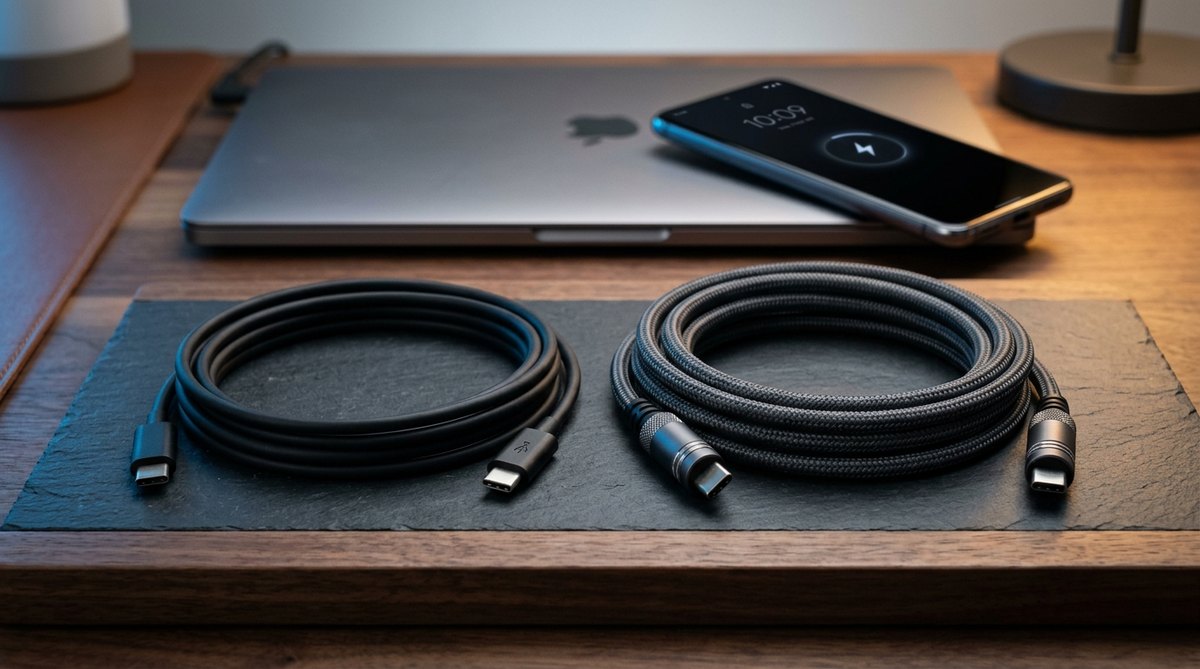
When shopping for a Type-C charging cord, you will encounter two main electrical ratings: 3-Ampere (3A) and 5-Ampere (5A). While both connectors look identical from the outside, choosing between a 3A vs 5A USB-C cable makes the difference between fast charging your phone at full speed and leaving your laptop or flagship smartphone charging at a crawl.
Many buyers assume that any USB-C cable will charge their device at maximum speed if they own a powerful wall charger. However, electrical current limits, internal wire gauge thickness, and built-in microchips dictate exactly how much power flows safely into your battery. In this guide, we break down the engineering reality, explain the confusing Samsung 45W charging trap, and recommend our top tested picks available in India. For matching charging adapters, explore our best fast charger for Android guide or check out our live electronics deals hub.
⚡ Quick Answer: 3A vs 5A at a Glance
Short on time? Here is the straightforward buying rule to follow right now:
- 🔹 Buy a 3A (60W) Cable if: You are charging standard smartphones (iPhones 15/16, Google Pixel, basic Android phones), iPads, Bluetooth earbuds, or power banks. They are thinner, lighter, more flexible, and cost less (₹199 – ₹349).
- 🔹 Buy a 5A (100W / 240W) Cable if: You are charging laptops (MacBook Pro/Air, Dell XPS, ThinkPad), high-capacity power banks, or Samsung phones supporting 45W Super Fast Charging 2.0 (Galaxy S24 Ultra, S23 Ultra, S22+, Tab S9). They contain mandatory E-Marker safety chips and thicker copper wires (₹599 – ₹1,299). Read our dedicated comparison on 60W vs 100W USB-C cables for a full wattage breakdown.
- ⚠️ The Golden Rule: 5A cables are 100% backward-compatible. A 5A cable can safely charge a small 18W phone, but a 3A cable will permanently bottleneck a 100W laptop or 45W Samsung phone down to slower speeds.
Comparison: 3A (60W) vs 5A (100W / 240W) USB-C Cables
To see how the two cable tiers differ across electrical safety, construction, and pricing, review our side-by-side technical specification comparison:
| Feature / Metric | 3A USB-C Cable (Standard) | 5A USB-C Cable (High-Power) | Why It Matters to Buyers |
|---|---|---|---|
| Maximum Current | 3 Amperes (3A) | 5 Amperes (5A) | Determines the maximum electrical flow without overheating. |
| Max Power Delivery (Wattage) | Up to 60W (20V × 3A) | Up to 100W (20V × 5A) or 240W (EPR) | Dictates whether laptops or fast-charging phones charge at full speed. |
| Electronic Marker (E-Marker) Chip | Not Required (Passive) | Mandatory (Active USB-IF IC) | Prevents fire hazard by safely communicating cable limits to chargers. |
| Samsung 45W PPS Charging | Bottlenecks down to 25W | Unlocks Full 45W Speeds | Samsung 45W requires 5A current (9V/5A or 10V/4.5A). |
| Internal Wire Gauge (AWG) | Thinner conductors (24–28 AWG) | Thicker copper wiring (20–22 AWG) | Thicker copper lowers internal resistance and heat generation. |
| Cable Flexibility & Weight | Very flexible, slim, lightweight | Noticeably stiffer, heavier, thicker | 3A is easier for daily pocket carry; 5A is built like a heavy power cord. |
| Data Transfer Speed | Typically USB 2.0 (480 Mbps) | Typically USB 2.0 (unless marked USB 3.2) | High amperage does not equal high data speed. |
| Average Price in India | ₹199 – ₹349 | ₹599 – ₹1,299 | E-Marker chips and heavier copper increase manufacturing costs. |
Difference Between 3A and 5A Cable: The Core Hardware Breakdown
To truly understand the difference between 3A and 5A cable designs, we have to look at elementary electrical physics. Electrical power (Watts) delivered by any charging setup is calculated using the formula:
Power (Watts) = Voltage (Volts) × Current (Amperes)
Under the universal USB Power Delivery (USB-PD 3.0) protocol, the maximum voltage allowed for standard chargers is 20 Volts. When you plug in a standard 3-Amp cable, the maximum mathematical power transfer is capped at 20V × 3A = 60 Watts. If a device attempts to pull more than 3 Amperes through standard wire, thin copper conductors overheat, causing voltage drops and melting plastic insulation.
In contrast, a 5-Amp cable is engineered with substantially thicker internal power conductors (typically 20 or 21 American Wire Gauge copper). By handling up to 5 Amperes at 20 Volts, it safely delivers 20V × 5A = 100 Watts of power. Furthermore, under the latest USB-PD 3.1 Extended Power Range (EPR) specification, voltage can scale up to 48 Volts, allowing 5A cables to transmit a staggering 240 Watts (48V × 5A) to high-performance gaming laptops.
What is a 5A Cable and Why Does It Need an E-Marker Chip?
Many shoppers ask what is a 5A cable and why it carries a higher price tag than budget cords. Beyond heavier copper wiring, the defining feature of every authentic 5A cable is an internal integrated circuit called an Electronic Marker (E-Marker) chip.
The USB Implementers Forum (USB-IF) strictly mandates that any cable intended to carry more than 3 Amperes or deliver over 60 Watts must feature an E-Marker chip embedded inside one or both connector collars. This tiny microcontroller acts as an intelligent passport for the cable. When connected, the charger and device communicate over the Configuration Channel (CC) wire. The E-Marker chip signals:
- Maximum supported current (5A vs 3A)
- Maximum voltage rating (20V for 100W, or 48V for 240W EPR)
- Manufacturer identification and USB-IF test certification
- Thermal resistance thresholds
If you connect a high-wattage 100W GaN charger to a modern laptop using an ordinary cable without an E-Marker chip, the charger will immediately detect the missing chip and refuse to output more than 3A (60W). This built-in fail-safe protects you from fire hazards and burnt connector pins.
60W vs 100W USB-C Cable: The Samsung 45W Charging Paradox
The most common customer confusion around a 60W vs 100W USB-C cable involves Samsung smartphones. Buyers often ask: “My Samsung Galaxy S24 Ultra only charges at 45W. Since 45W is lower than 60W, why can’t I just use a cheap 60W cable?”
The answer lies in Samsung’s Super Fast Charging 2.0 implementation, which relies on the USB-PD PPS (Programmable Power Supply) protocol:
- Samsung achieves 45W charging by pushing 9 Volts at 5 Amperes (or approximately 10V at 4.5A).
- Notice the crucial specification: it demands 5 Amperes of electrical current.
- A standard 60W cable is hardware-limited to 3 Amperes.
When you plug a 45W Samsung wall charger into a 60W/3A cable, the phone’s charging controller detects the 3A hardware ceiling. To avoid overheating the cable, the phone steps down to its 25W charging profile (9V × 2.77A). Even though you paid for a 45W charger, you are only receiving 25W speeds! To unlock true 45W Super Fast Charging 2.0 on Galaxy S-series Ultra models, you must use a 5A (100W-rated) cable.
The Data Transfer Trap: High Wattage Does NOT Mean Fast Data
A widespread myth in the tech community is assuming that a thick 100W or 240W 5A cable automatically transfers files quickly. In reality, charging wattage and data transmission speeds use completely separate copper lines inside the cable jacket:
- Over 90% of affordable 100W 5A cables sold in India are wired with USB 2.0 data speeds (480 Mbps). Transferring a 10GB video file with one of these cables takes over 3.5 minutes.
- To transfer files at high speeds (10 Gbps USB 3.2 Gen 2 or 40 Gbps Thunderbolt/USB4), a cable requires up to 16 additional high-speed shielded data lines.
- High-speed data cables are noticeably stiffer, significantly more expensive (₹1,500 – ₹3,000+), and rarely exceed 1 meter in length.
If you only need a cable to charge your phone, laptop, or power bank, a USB 2.0 charging-focused 100W 5A cable is ideal because it is more flexible and budget-friendly. Only invest in a USB 3.2/USB4 cable if you frequently transfer massive RAW files to external SSDs or connect to 4K external monitors.
Top Tested 3A and 5A USB-C Cables in India
To help you choose the right cable for your devices, here are our top-rated recommendations across both 3A and 5A tiers, verified for safety, build quality, and live availability. For our broader rankings of durable braided cords across all budget tiers, explore our complete guide to the best Type C cables for fast charging in India.
1. Samsung Original 5A Type-C to Type-C Cable (EP-DN975)
Best for: Samsung Galaxy S24 Ultra, S23 Ultra, S22+, and Galaxy Tab S9 owners seeking genuine 45W Super Fast Charging 2.0.
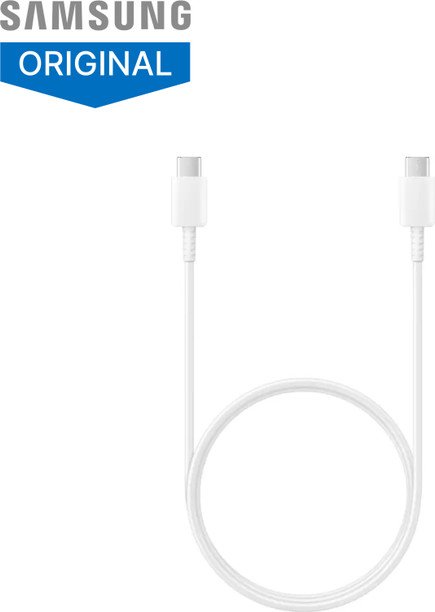
Price Range: ₹999 – ₹1,299 (as of October 2026) | User Rating: 4.4 / 5 (14,000+ reviews)
This is the official 5A cable engineered by Samsung to accompany its 45W travel adapter. While standard Samsung phones ship with basic 3A cables in the box, the EP-DN975 integrates heavier copper gauge wiring and an authentic Samsung E-Marker chip that negotiates the high-current 9V/5A PPS profile flawlessly.
It supports up to 100W Power Delivery, making it equally capable of fast-charging an Apple MacBook Pro or a Windows ultrabook. The thick TPE rubber jacket is reinforced at the neck collars to prevent internal wire breakage from repetitive twisting.
Key Specifications:
- Rating: 5A Max / 100W (20V/5A and 9V/5A PPS)
- Length: 1.0m / 1.8m options
- E-Marker Chip: Authentic Samsung Certified IC
- Data Speed: USB 2.0 (480 Mbps)
Pros:
- Guaranteed compatibility with Samsung 45W Super Fast Charging 2.0.
- Official Samsung OEM build quality with low electrical resistance.
- Full 100W capacity easily charges modern laptops and tablets.
Cons:
- Smooth TPE rubber jacket is less abrasion-resistant than braided nylon.
- Commands a noticeable price premium over domestic Indian cables.
Verdict: The essential, zero-risk choice for Samsung flagship owners who want to guarantee full 45W charging speeds without compatibility headaches.
Check Price on Amazon Check Price on Flipkart
2. Anker 543 100W USB-C to USB-C Cable (Bio-Braided)
Best for: Professionals who need bulletproof durability for 100W MacBook Pro, iPad Pro, and Windows gaming laptops.
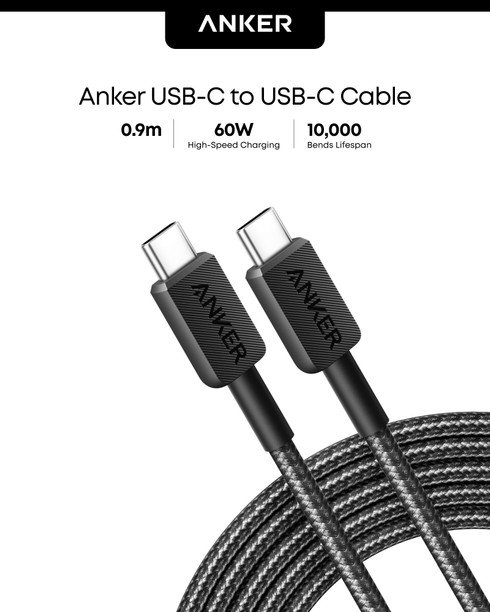
Price Range: ₹999 – ₹1,299 (as of October 2026) | User Rating: 4.5 / 5 (19,000+ reviews)
Anker’s 543 series represents the gold standard in heavy-duty 5A charging cables. Built using a bio-based nylon braid derived from plant-based materials, the cable is rated to survive over 25,000 severe bends without internal copper conductor fatigue.
It houses an authentic USB-IF certified E-Marker chip that safely negotiates 20V/5A power profiles with high-wattage GaN chargers. Whether powering a power-hungry 16-inch laptop or topping up a compact power bank, the connector remains cool and secure.
Key Specifications:
- Rating: 100W Max (20V/5A Power Delivery)
- Bend Lifespan: Certified 25,000+ bends
- Connector Housing: Anodized aluminum with extended strain relief
- Data Speed: USB 2.0 (480 Mbps)
Pros:
- Exceptional tensile strength resists office chair wheels and pet chewing.
- Official USB-IF certification guarantees strict electrical compliance.
- Eco-friendly bio-braided outer sheath resists fraying and fuzzing.
Cons:
- Noticeably stiffer than lightweight silicone cables.
- Higher initial investment than domestic Indian alternatives.
Verdict: The most durable 100W 5A charging cable available in India, perfect for users tired of frayed cords.
Check Price on Amazon Check Price on Flipkart
3. Stuffcool Bolt 100W Type-C to Type-C Braided Cable
Best for: Buyers wanting a premium 100W 5A cable from a reputed Indian tech brand at a competitive price.
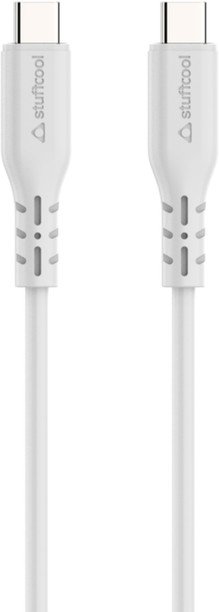
Price Range: ₹599 – ₹799 (as of October 2026) | User Rating: 4.3 / 5 (8,000+ reviews)
Stuffcool has emerged as a premier Indian accessory brand specializing in GaN chargers and heavy-duty cables. The Bolt 100W is an authentic 5A cable designed specifically to bridge the price gap between budget cords and imported flagships.
It features polished zinc-alloy connector housings that resist accidental drops on tile floors. An integrated smart E-Marker controller continuously balances current flow to prevent overheating during prolonged laptop charging sessions.
Key Specifications:
- Rating: 100W (20V/5A Max)
- Length: 1.2 meters / 4 feet
- Chassis: Heavy-duty braided nylon with zinc-alloy collar
- Compatibility: USB-PD 3.0, QC 4.0, PPS
Pros:
- Substantially more affordable than imported premium brands like Belkin or Anker.
- Generous 1.2-meter length provides extra slack near bedside or desk plugs.
- Strong zinc-alloy collar prevents connector bends.
Cons:
- Slightly thicker braid makes tight coiling difficult for small pencil cases.
- Data speed is capped at standard USB 2.0 (480 Mbps).
Verdict: The best value 100W 5A cable in India, delivering flagship build quality without the steep imported price markup.
Check Price on Amazon Check Price on Flipkart
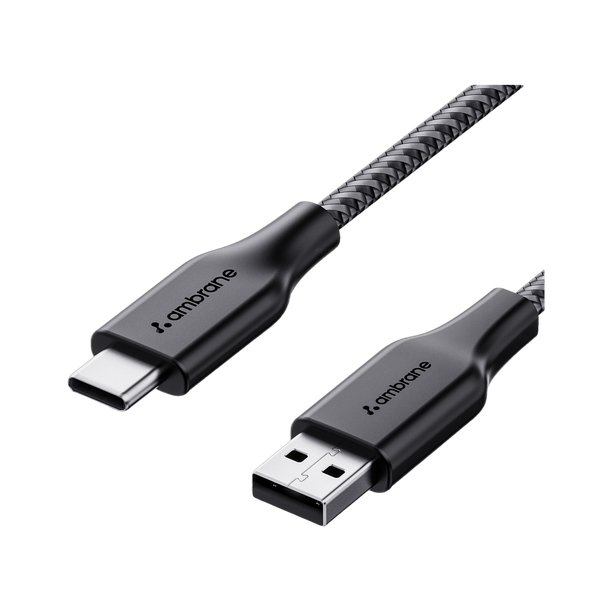
4. Ambrane 60W Type-C to Type-C Braided Cable
Best for: Standard smartphone users, iPhone 15/16 owners, and budget-conscious daily carry.
Price Range: ₹199 – ₹299 (as of October 2026) | User Rating: 4.1 / 5 (35,000+ reviews)
If you only need a cable to charge standard Android phones, an iPhone 15 or 16, or a 10,000mAh power bank (such as those featured in our power banks under ₹1000 guide), buying an expensive 5A cable is unnecessary. Ambrane’s 60W braided cable is our top budget 3A pick.
Because it operates at 3A, the internal wiring does not require bulky insulation, resulting in a significantly lighter and more flexible cable that easily wraps around your fingers. It delivers full 60W (20V/3A) speeds, comfortably charging iPads and lightweight laptops.
Key Specifications:
- Rating: 60W Max (20V/3A Power Delivery)
- Length: 1.0m / 1.5m options
- Type: 3A Passive Cable
- Material: High-density nylon braid
Pros:
- Incredible value under ₹250 during sales.
- Highly flexible and lightweight; perfect for everyday pocket and bag carry.
- Easily fast-charges iPhones, Pixels, and mid-range Android devices.
Cons:
- Cannot supply more than 60W to power-hungry laptops.
- Will bottleneck Samsung 45W phones down to 25W speeds.
Verdict: The smartest budget daily driver for phones and tablets, offering great flexibility at a rock-bottom price.
Check Price on Amazon Check Price on Flipkart
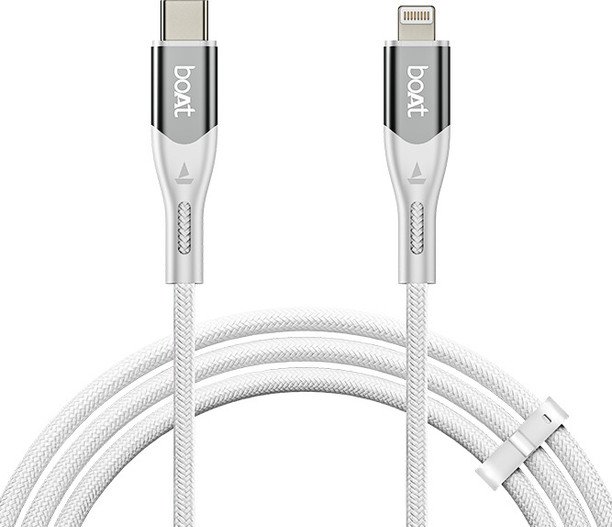
5. boAt Rugged Type-C to Type-C 60W Braided Cable
Best for: Rough daily commuters needing heavy-duty strain relief on a 3A budget.
Price Range: ₹249 – ₹349 (as of October 2026) | User Rating: 4.1 / 5 (22,000+ reviews)
boAt is synonymous with rugged budget accessories in India, and their Rugged 60W Type-C cable is designed specifically to withstand harsh daily wear. It incorporates extra-long, flexible rubberized strain relief collars that shield the delicate neck joints from snapping during sharp pulls.
Operating as a dedicated 3A cable, it delivers up to 60W of Power Delivery, making it ideal for standard smartphones, wireless neckbands, and portable power banks. The tightly woven cotton-nylon exterior resists tangling inside crowded backpacks.
Key Specifications:
- Rating: 60W (20V/3A)
- Strain Relief: Extended rubber collar jacket
- Length: 1.0 meter
- Compatibility: USB-PD 3.0 & QC 3.0
Pros:
- Sturdy strain-relief collars prevent neck tearing.
- Affordable price tag widely available across Indian retail stores.
- Tangle-resistant braided outer jacket.
Cons:
- Plastic connector collars are slightly chunky and may foul very thick phone cases.
- Limited to 3A current; cannot deliver 45W to Samsung Ultra phones.
Verdict: A reliable, ultra-tough 3A cable designed for college students and commuters who frequently break basic charging cords.
Check Price on Amazon Check Price on Flipkart
Buying Guide: How to Choose Between a 3A and 5A Cable
When selecting your next charging cable, use this practical decision checklist to avoid overpaying or bottlenecking your hardware:
1. Identify Your Highest-Draw Device:
If you own a single laptop that charges via USB-C (even a 65W ThinkPad or MacBook), buy a 5A (100W) cable. While 65W is technically close to 60W, many 65W chargers operate at 20V/3.25A. That extra 0.25 Amperes exceeds the 3A hardware limit, causing the charger to throttle down to 45W or 60W. A 5A cable ensures your laptop always draws its full rated wattage.
2. Check for Samsung 45W Fast Charging:
If you own a Galaxy S24 Ultra, S23 Ultra, S22+, S20 Ultra, or Galaxy Tab S8/S9, do not purchase a 3A cable. You must purchase a 5A cable to negotiate the 9V/5A PPS profile required for Super Fast Charging 2.0.
3. Proprietary Fast Charging in India (OnePlus, Realme, Xiaomi):
Keep in mind that OnePlus SuperVOOC (65W/80W/100W) and Realme Dart charging do not use standard USB-PD. They require proprietary high-amperage cables (often 6.5A or 7.3A) with custom pinouts. Using a standard 100W PD cable on a OnePlus phone will safely charge the phone, but only at standard USB-PD speeds (typically 18W to 27W). For proprietary brands, always use the brand’s original charging cord.
4. Look for USB-IF Certification on 5A Cables:
Because 5A cables carry high electrical current, uncertified budget cables from unknown brands pose serious fire risks. Always buy cables certified by the USB Implementers Forum (USB-IF) or from trusted brands like Samsung, Anker, Stuffcool, Belkin, or Ambrane.
Common Mistakes When Buying USB-C Cables
Avoid these four costly mistakes Indian buyers frequently make:
- Assuming All USB-C Cables Charge at the Same Speed: Plugs look identical, but a 3A cable cannot physically deliver the current required for 100W laptops or 45W Samsung phones.
- Buying Fake “120W” Cables from Street Vendors: Cheap unbranded cables sold at local railway stations or street markets often use thin 28 AWG wire with fake resistor tags. Drawing high current through them causes dangerous heat buildup that can ruin your phone’s USB port.
- Expecting High-Speed Data from a Charging Cable: Over 90% of 100W charging cables use USB 2.0 data lines (480 Mbps). If you need fast external SSD file transfers or monitor display output, you must look specifically for USB 3.2 Gen 2 or USB4 markings.
- Using 2-Meter Cables for High Current: The longer the cable, the higher the electrical resistance. For 5A high-current charging, stick to 1.0m or 1.2m cables for optimal efficiency and minimal voltage sag.
Frequently Asked Questions (FAQs)
Can a 5A cable damage a phone that only supports 3A charging?
No, a 5A cable will never damage your device. Modern USB-C charging relies on smart communication between the charger and phone. The device only pulls the exact current it requires. If your phone only supports 2A or 3A, the 5A cable will safely deliver 2A or 3A without overheating or overloading.
How do I know if my existing USB-C cable is 3A or 5A?
5A cables are typically marked with a “100W”, “240W”, or “5A” logo on the connector collar, and they are noticeably thicker and stiffer. Alternatively, when plugged into a 100W laptop or Samsung 45W charger, a 5A cable will display full charging speeds, whereas a 3A cable will show lower wattage warnings.
Why are 5A cables more expensive than 3A cables?
5A cables require thicker internal copper conductors (20–22 AWG) to reduce electrical resistance, multi-layer shielding, and an active internal microchip known as an E-Marker. These high-spec materials and safety certifications increase production costs compared to simple passive 3A cables.
Can a 60W (3A) cable charge a MacBook Pro?
Yes, a 60W cable can charge a MacBook Pro, but at a reduced speed. If your MacBook Pro comes with an 87W, 96W, or 140W charger, using a 60W cable will cap power intake at 60W. Under heavy processing loads, the laptop battery may drain faster than the charger can supply power.
Does a 5A cable charge phones faster than a 3A cable?
For most standard smartphones (iPhones, Google Pixels, mid-range Androids), a 5A cable will not charge any faster because the phone itself is limited to 20W–30W (less than 3A). The only major exception is Samsung phones supporting 45W PPS, which require 5A current to unlock maximum speeds.
What happens if a 100W cable does not have an E-Marker chip?
If a cable claims to support 100W but lacks a certified E-Marker chip, compliant USB Power Delivery chargers will recognize the missing chip and refuse to output more than 3A (60W). If an uncertified cable forces 5A without safety chips, it can overheat, melt, or cause short circuits.
Are all 5A cables compatible with OnePlus SuperVOOC?
No. OnePlus SuperVOOC uses proprietary charging protocols requiring specialized cables with custom pin signaling (such as 6.5A or 7.3A). A standard USB-PD 5A cable will only charge a OnePlus device at basic USB Power Delivery speeds (typically 18W to 27W), not 65W or 80W.
Final Verdict: Which Cable Should You Choose?
When deciding between a 3A and a 5A Type-C cable, let your device lineup guide your purchase. If you only need a flexible, affordable cord for an iPhone 15/16, Google Pixel, or basic power bank, the Ambrane 60W Braided Cable or boAt Rugged 60W Cable offers the perfect balance of flexibility, durability, and value under ₹350.
However, if you own a USB-C laptop, MacBook Pro, high-capacity power bank, or a Samsung Galaxy phone with 45W charging capabilities, investing in an authentic 5A cable like the Samsung Original 5A Cable or the rugged Anker 543 100W Cable is essential to unlock full, unrestricted charging speeds without risking hardware safety.
Before placing your order, check our live Electronics Deals Hub for current coupon codes and bank card discounts on chargers and cables.

Pradeep Kumar is a passionate writer and product enthusiast who loves exploring smart, practical, and thoughtfully designed products. With a keen eye for detail, he researches specifications, compares features, and studies real buyer feedback to create easy-to-follow buying guides on mobile accessories, electronics, and everyday essentials. His goal is to help readers choose the right product with confidence and find genuine value in every purchase.